
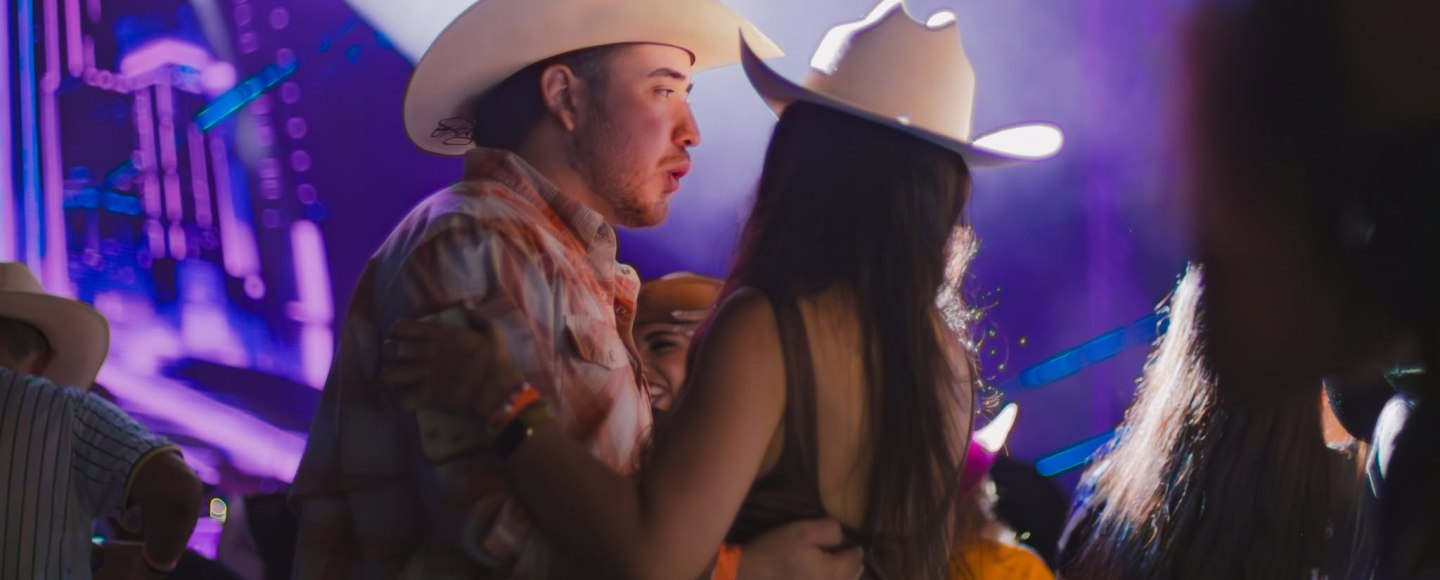


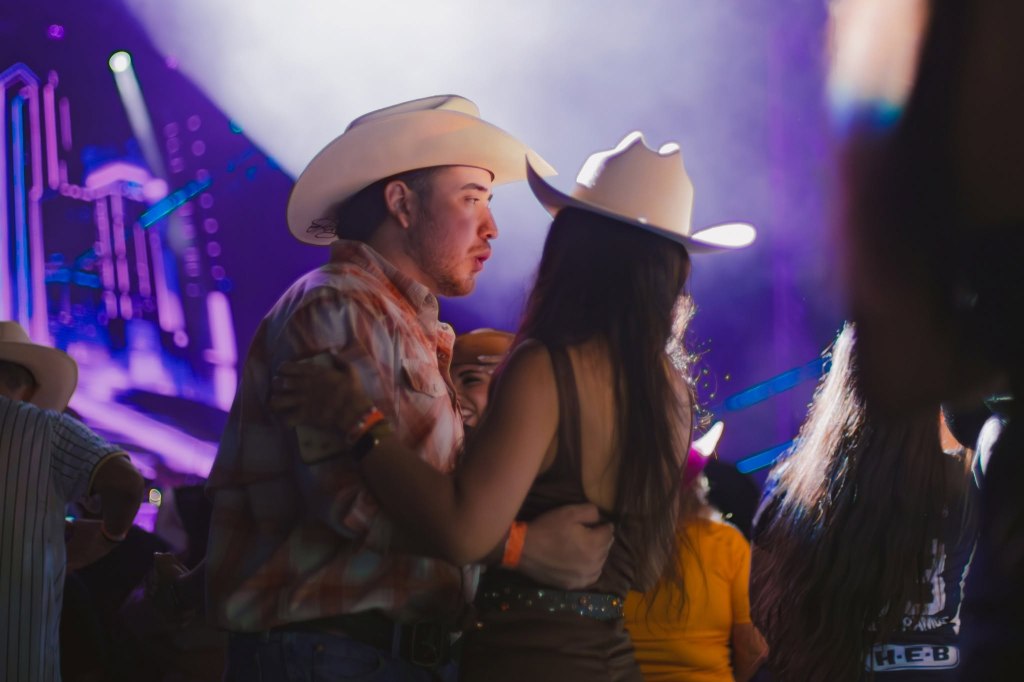
The rumble in the caliche parking lot can be felt as soon as your boots hit the ground. With every step towards the door, the earth trembles and the beat rattles in your chest. As you pull the handle and step into the room, you’re hit with a surge of neon light that rushes past you, escaping into the darkness. The booming bass and kickdrum, confidently rolling on the wheels of that 4/4 beat, pound out the compás as the accordion melodies cut like razor wire through the Marlboro smoke and the clinking of longneck beer bottles.
A whirlpool of twirling dresses and 10-gallon cowboy hats move swiftly along the dance floor, their bodies in constant movement, their smiles visible from the farthest stool at the bar. As a new song starts, a young woman laughs and grabs the hand of her partner, dragging him toward the dance floor. He raises his eyebrows and winks at his friends. The lucky cowboy turns and, with a nervous laugh, joins the lady for the first of a lifetime of dances.
In between the metal-legged plastic chairs, small children sleep as their parents chat with their compadres over a bottle of Crown Royal and a setup. Less than 20 feet away from where they lay, their older siblings and primos learn to dance cumbia from everyone’s favorite tía.
If you didn’t know any better, you’d think you had stepped back in time 50 years. But if you ask anybody from around those parts, they’ll tell you that it’s just another Saturday night in South Texas.
From quinceañeras and weddings to anniversaries, parish festivals, Saturday night tocadas, and Sunday afternoon tardeadas, there’s one thing that can be said with certainty about Tejanos: we love a good party.
In our culture, it’s not just an excuse to throw back some chelas, crank up the tunes, and burn some fajitas, either. It’s a cultural touchstone. It’s a time when friends, relatives, and neighbors gather to pass on important news, swap stories, share laughs, and yes, drink some beer and eat a taco or three.
Despite the most common understanding of the word, Tejano isn’t just a type of music. It’s also a people, a culture, and a way of life. Tejano means Texan, an appropriate translation given that our people and our music are integral to the story of Texas.
Our music is roots music in the truest sense of the word. It’s rooted in the calloused hands of the field worker, the sweat on the brow of the day laborer, the worn soles on the shoes of the factory worker, and the bright, hopeful look in the eyes of the new college graduate. It is the soundtrack of our history, our struggle, and our place in American culture.
Tejanos have come far in the last century. If you want proof of that, just look at our story through the lens of the music.
What began in the labor camps of South Texas and the crowded barrio dance halls of the city later traveled with the working class from Chicago to Las Cruces, Detroit to Los Angeles.
To understand the appeal and true power of Tejano music, you have to start at the beginning—with conjunto and orquesta.
These two styles of proto-Tejano music took slightly different approaches to accomplish the same goal: to create music that not only got people dancing but also spoke to their unique Mexican-American experience through the eyes of those living it.
Mexican-Americans had a strong faith in God and a reputation as hardworking, resilient people. But if they were to feel at home in 20th-century America, they would need to stick together and build communities that felt like home.
Fortunately, Mexican culture already had a tried-and-true method for bringing people together: La fiesta.
The Birth of Conjunto
In the 1930s, working-class Tejanos often gathered in the front rooms of neighborhood homes, bringing entire communities together under one roof.
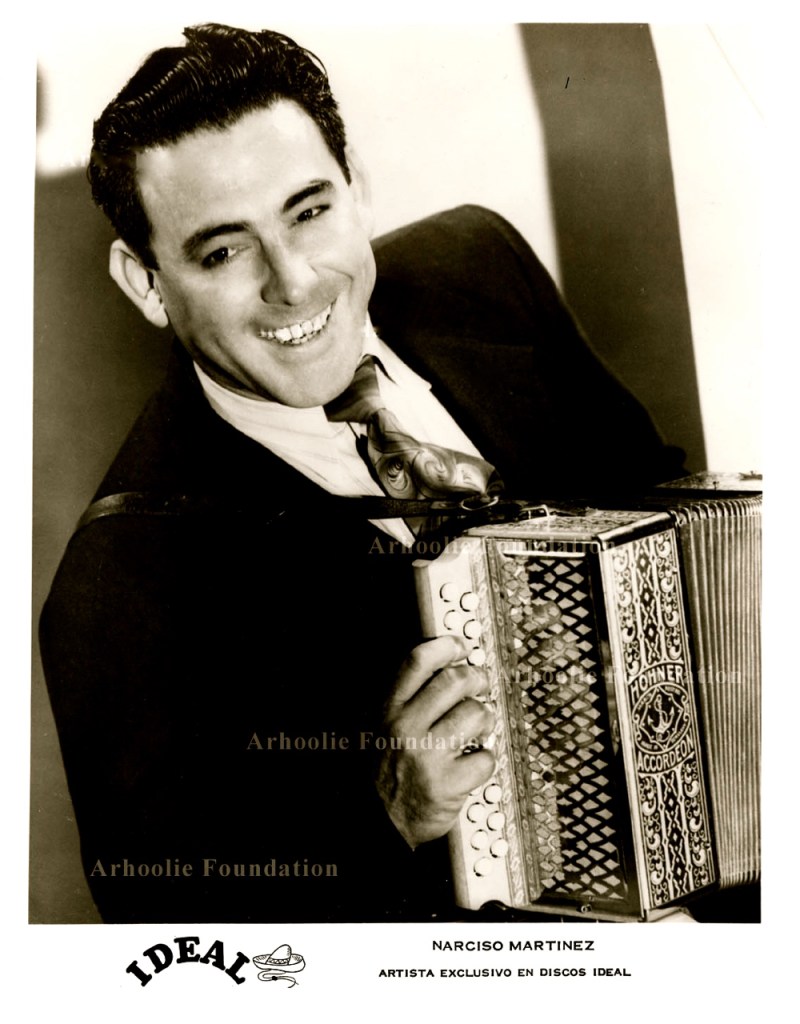
Musicians like Narciso Martínez (“El Huracán del Valle”), Valerio Longoria, and Santiago Jiménez Sr.—father of Texas accordion legend Flaco Jiménez—got their start playing these intimate gatherings and local dance halls while working in the fields during the day.
The blending of Mexican traditions with the German and Czech immigrant influences of South Texas and Northern Mexico created fertile ground for experimentation. The marriage of the 12-string bajo sexto with the button accordion—and later the tololoche—formed the backbone of what would become conjunto music.
While singers like Lydia Mendoza were finding success with rancheras and boleros, this new accordion-driven sound initially flourished through instrumental music.

Polkas, waltzes, schottisches, redovas, and huapangos merged into something entirely new. By reshaping these styles, pioneering musicians created a distinctly Tex-Mex sound that belonged to the working class.
When vocals were eventually added, they told stories of heartbreak, new love, hard labor, discrimination, and perseverance. The struggles of Mexican-Americans in Texas had finally found their own voice.
The Rise of Orquesta
While conjunto thrived in rural Texas, another musical movement was growing in urban dance halls.
Saxophonist Alberto “Beto” Villa envisioned blending traditional Mexican music with the popular swing and big band sounds of the era.
The result was the birth of Tejano orquesta.
In 1947, Villa partnered with pioneering producer Armando Marroquín at Ideal Records in Alice, Texas, helping bring this exciting new fusion to vinyl.
A year later, Villa recorded alongside Narciso Martínez, successfully combining the earthy sound of conjunto with the sophisticated elegance of ballroom orchestras.
The experiment proved wildly successful.
Beto Villa y Su Orquesta toured throughout Texas and eventually across the country, drawing crowds that demonstrated the growing influence of Tejano music. In 1952, the group performed before more than 10,000 people at a Chicago ballroom.
Soon, bandleaders such as Isidro López and Agustín Ramírez expanded the movement with their own distinct musical styles.
Over the decades, Tejano artists continued evolving by incorporating jazz, blues, soul, country, R&B, rock, heavy metal, new wave, synth-pop, hip-hop, rap, dance, and techno.
Yet despite those innovations, the mission remained unchanged: Create music that people can feel. Create music that people can dance to.
More Than Music
Even the briefest look at Tejano music’s origins reveals a powerful relationship between a people and their art.
As Tejanos created their own sound, they strengthened their identity, built pride within their communities, and inspired future generations to continue telling their stories through music.
Simply put, the music and the people grew stronger together. It was made for us, by us, during times when all we had was each other.
The cultural identity formed by those pioneers of La Onda Tejana became armor against poverty, oppression, and discrimination. Our history hasn’t always been preserved in textbooks or museums.
For many Tejanos, it has been preserved in songs. That is why preserving this music matters. It safeguards our identity, our history, and our connection to one another. Knowing who we are and where we come from gives us the freedom to be ourselves—with pride.
The Responsibility of the Next Generation
Honoring Tejano music means more than celebrating the classics. It also means encouraging the next generation of musicians to innovate and build upon the foundation laid by those who came before them.
If we provide young artists with the support and creative freedom they deserve, they will continue creating music that reflects our culture while introducing it to new audiences around the world.
They represent La Onda, and their future depends on the support we give them today.
If we want our children and grandchildren to inherit the same sense of belonging, pride, and community our parents and grandparents passed down to us, then we must continue investing in our culture.
As the next generation of Tejanos, we write our own legacy every day—in every dance, every gathering, every song, and every story.
It is up to us to decide what the next chapter looks like.
Follow Tejano Nation on Facebook, X (formerly Twitter), and Instagram, and subscribe to our YouTube channel to keep up with everything Tejano. Listen to new Tejano music first with our Spotify playlists and iHeartRadio podcast.


Public Voting Now Open for the 46th Annual Tejano Music Awards
Fans can vote for their favorite Tejano artists through October 18 as the awards show prepares to return to Katy, Texas, for the second consecutive year

Marlissa Vela Honors Her Father’s Legacy With New Single ‘Me Voy Al Amanecer’
The Tejano singer-songwriter unveils the fourth single honoring her father, Ruben Vela, after overcoming personal hardships and production setbacks

Alexis Aliyah Debuts With New Single and Music Video ‘Contigo’
The daughter of Grupo Negami frontman Carlos Villegas begins carving out her own musical identity with a soulful love song
Discover more from Tejano Nation
Subscribe to get the latest posts sent to your email.


0 comments on “Queremos Bailar!: The Enduring Spirit and Legacy of Tejano Music”